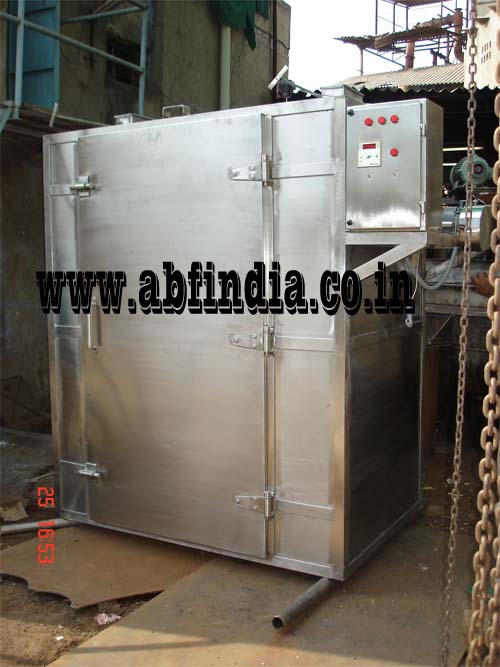
About a Tray Dryer
A tray dryer is a widely used industrial drying equipment designed to remove moisture from various substances, typically in batch quantities. It consists of a stack of trays or shelves where the material to be dried is placed. These trays are then subjected to controlled hot air circulation, leading to the evaporation of moisture from the materials.
How Does a Tray Dryer Work?
The operation of a tray dryer involves a simple yet effective process. The trays, loaded with the wet substance, are placed inside the dryer’s chamber. The dryer’s heating system generates hot air, which is evenly circulated within the chamber. As the hot air passes through the trays, it absorbs the moisture from the material, turning it into vapor. The moisture-laden air is then expelled from the chamber, while the dry air continues the cycle. This process continues until the desired level of dryness is achieved.
Types of Tray Dryers
Tray dryers come in various types, each catering to specific drying needs. Some common types include:
- Batch Tray Dryers: These are the most basic type, suitable for small-scale operations.
- Convection Tray Dryers: They use forced convection for faster drying.
- Vacuum Tray Dryers: Operating under reduced pressure, they are ideal for heat-sensitive materials.
- Continuous Tray Dryers: Designed for large-scale production, they allow a continuous flow of materials.
Advantages of Using Tray Dryers
Tray dryers offer several advantages, making them a preferred choice in various industries:
- Uniform Drying: The controlled airflow ensures uniform drying across all trays.
- Batch Processing: Ideal for small batches and varied products.
- Gentle Drying: Low drying temperatures prevent damage to heat-sensitive materials.
- Easy Monitoring: Transparent chamber allows visual inspection during drying.
Key Components of a Tray Dryer
Tray dryers consist of several essential components, including:
- Chamber: The main housing where the trays are stacked and drying occurs.
- Trays: Shelves where materials are placed for drying.
- Heating System: Generates hot air for the drying process.
- Air Circulation System: Ensures even distribution of hot air within the chamber.
- Exhaust System: Expels moisture-laden air from the chamber.
Factors to Consider When Choosing a Tray Dryer
Selecting the right tray dryer involves considering several factors:
- Material Compatibility: Ensure the dryer is suitable for the material you’re working with.
- Capacity: Choose a dryer that matches your production requirements.
- Energy Efficiency: Opt for models with efficient heating and airflow systems.
- Maintenance Needs: Consider ease of cleaning and maintenance.
Step-by-Step Guide to Operating a Tray Dryer
Operating a tray dryer effectively involves the following steps:
- Preparation: Load the material onto the trays evenly and avoid overcrowding.
- Setting Parameters: Set the desired temperature and drying time on the control panel.
- Starting the Dryer: Switch on the heating and air circulation systems.
- Monitoring: Regularly check the drying progress and adjust parameters if needed.
- Cooling Down: Once drying is complete, allow the material to cool before removing it.
- Unloading: Carefully remove the dried material from the trays.
Maintenance and Cleaning of Tray Dryers
Proper maintenance ensures the longevity and efficiency of your tray dryer:
- Regular Cleaning: Clean trays, filters, and chambers after each use.
- Inspect for Wear: Check heating elements and fans for any signs of damage.
- Lubrication: Keep moving parts well-lubricated to prevent friction-related issues.
- Electrical Checks: Regularly inspect wiring and connections for safety.
Common Challenges and Troubleshooting
Despite their efficiency, tray dryers can face certain challenges:
- Uneven Drying: Check for tray overloading or airflow blockages.
- Heat Variations: Ensure consistent temperature distribution throughout the chamber.
- Material Sticking: Use non-stick trays or liners to prevent adhesion.
- Maintenance Issues: Address wear and tear promptly to prevent breakdowns.
| Model |
TD-12 |
TD-24 |
TD-48 |
TD-96 |
TD-192 |
| Loading Capacity |
12 Trays |
24 Trays |
48 Trays |
96 Trays |
192 Trays |
| No. of Doors |
One |
One |
One |
Two |
Two |
| No. of Blowers |
One |
One |
One |
Two |
Four |
| No. of Motors / H.P. |
1 / 0.5 H.P. |
1 / 0.5 H.P. |
1 / 1 H.P. |
2 / 1 H.P. |
4 / 1 H.P. each |
| 3 phase 415 volts |
3 phase 415 volts |
3 phase 415 volts |
3 phase 415 volts |
3 phase 415 volts |
3 phase 415 volts |
Electrical Heating Load for
100°C / 200°C / 300°C |
3kw/6kw/9kw |
6kw/9kw/12kw |
9kw/15kw/18kw |
15kw/21kw/27kw |
36kw/42kw/48kw |
| Steam Heater No. of coils. |
2 |
2 |
2 |
2 |
2 |
| Steam Pressure |
3.3 kg / cm2 |
3.3 kg / cm2 |
3.3 kg / cm2 |
3.3 kg / cm2 |
3.3 kg / cm2 |
| Steam Consumption |
25 LBS / hr |
45 LBS / hr |
60 LBS / hr |
80 LBS / hr |
120 LBS / hr |
Insulation in mm
100°C / 200°C / 300°C |
50 / 75 /75 |
50 / 75 /75 |
50 / 75 /75 |
50 / 75 /75 |
50 / 75 /75 |
| No of Trolleys |
Rack System |
Rack System |
One |
Two |
Four |
| Tray Size |
812 x 406 x 31 |
812 x 406 x 31 |
812 x 406 x 31 |
812 x 406 x 31 |
812 x 406 x 31 |
| Trolley Dimension |
Fixed Racks |
Fixed Racks |
840 x 960 x 1780 |
840 x 960 x 1780 |
840 x 960 x 1780 |